The Legacy of Sister Margaret McCaffrey: “The Conscience of Shreveport” Can Still Be Seen Today
Towards the back of Shreveport’s historic Oakland Cemetery, the grave marker for Sister Margaret McCaffrey sits, shimmering a brilliant blue. Her simple rectangular marker reads “Child of the Trinity” and “Friend of the poor,” one under the other. Her grave is largely inconspicuous sitting beside the massive markers for the august names of Shreveport past.
Called the “Conscience of Shreveport” and “Mother Teresa of Louisiana,” Sister Margaret’s legacy is far larger than that simple stone could ever express. Spanning multiple organizations across the city, Sister Margaret’s legacy can be seen in the material, the immaterial, and in those who continue the work she set out to do over fifty years ago.
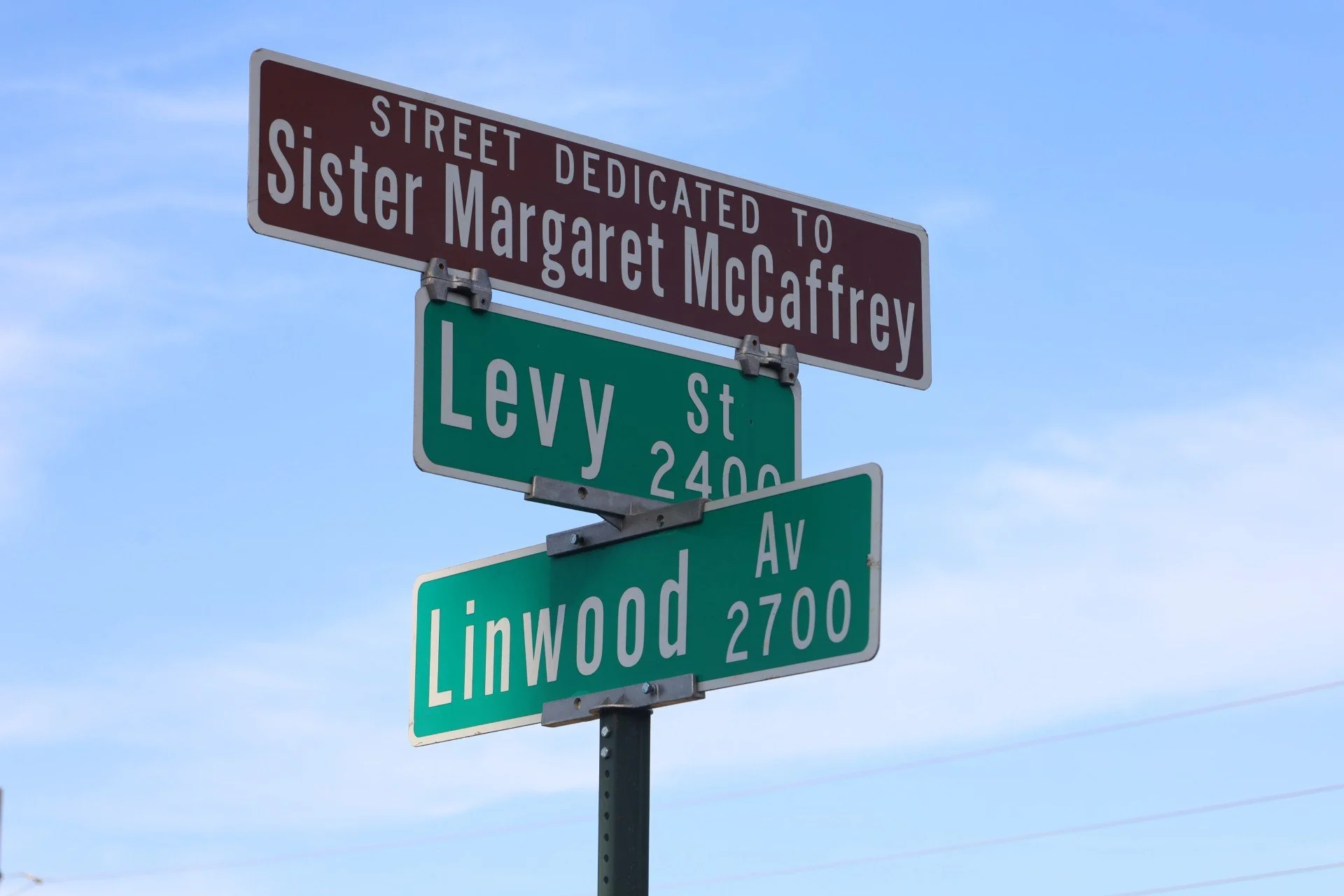
The intersection of Levy Street and Linwood Avenue. Home to Christian Services and Hope Connections, Levy Street was dedicated to Sister Margaret in 2020, which was also the 50th anniversary of Christian Services.
Who Was Sister Margaret?
Born in Birmingham, Alabama in 1928, she felt the religious calling from a young age. Bouncing from different cities for a while, she eventually met Father Murray Clayton in Alexandria, Louisiana. Father Murray Clayton of St. Joseph’s Catholic Church invited Sister Margaret McCaffrey to come to Shreveport. In 1970, she began working to alleviate the suffering of impoverished Shreveport citizens.
She started by providing meals to school children. She quickly gained the notoriety of someone willing to go where others would not. She set up her program in what used to be called St. Paul’s Bottoms, or more often referred to as The Bottoms. Known today as Ledbetter Heights, the area on the outskirts of downtown was known for its poverty.
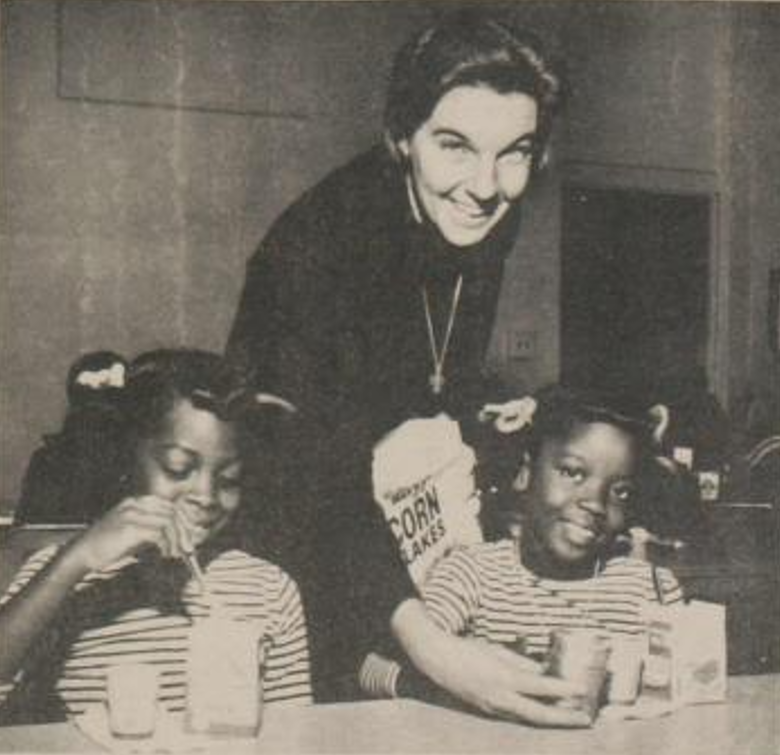
This is not the first time The Conglomerate has covered Sister Margaret. This photo of Sister Margaret was used on the cover page of an issue published on Friday, Feb. 16, 1973.
Funded solely by private donations, Sister Margaret spent her days interacting with those who needed help and meeting them where they were. Believing in the power of one-on-one connection, Sister Margaret spent a lot of her time driving from home to home, bringing money or food and visiting with families personally. Shreveport native Chris Hart said that it got to the point where if someone needed help paying a water bill, “Sister Margaret could call the water company and say ‘I’m going to send you a check’ and prevent a cut off before it happened. They got to know her and got to trust the name of Sister Margaret.”
In 1977, Chris Hart was in junior high when her mom, Anne Barberousse, started working with Sister Margaret. As Sister Margaret and Barberousse got closer, Hart got to know Sister Margaret on a personal level. “She enjoyed a good meal, a nice glass of wine, and a piece of chocolate cake after a long day of work.” Hart vividly remembers her mom and Sister Margaret laying on the couch, watching old movies, and eating chocolate bars.
Sister Margaret’s sweet tooth was one of her greatest vices. Sister Margaret would always give up chocolate for Lent and her birthday, March 9, would often fall during this time. Hart said, “mom would keep saying, ‘it’s okay, you can have a slice of chocolate cake on your birthday’ and all that kind of stuff.”
Rising at 5 a.m. every morning for mass, Sister Margaret kept her routine and extreme dedication to the Christian Services Program. One time, Barberousse bought them and Sister Margaret tickets to the symphony. After the show, they got in the car, and Hart remembers Sister Margaret immediately turning to her mom and asking about something to do with the program. “I said, ‘you can’t think about anything else except the program?’ and mom said not to bother Sister Margaret about it because she had a one-track mind about it.” Hart eventually moved away but said the lessons she learned from Sister Margaret stuck with her for the rest of her life.
Christian Services Today
In its fifty-sixth year, Christian Services now stands at 2346 Levy Street. Dedicated to Sister Margaret in 2020, Levy Street is home to both Christian Services and the homeless resource center, Hope Connections.
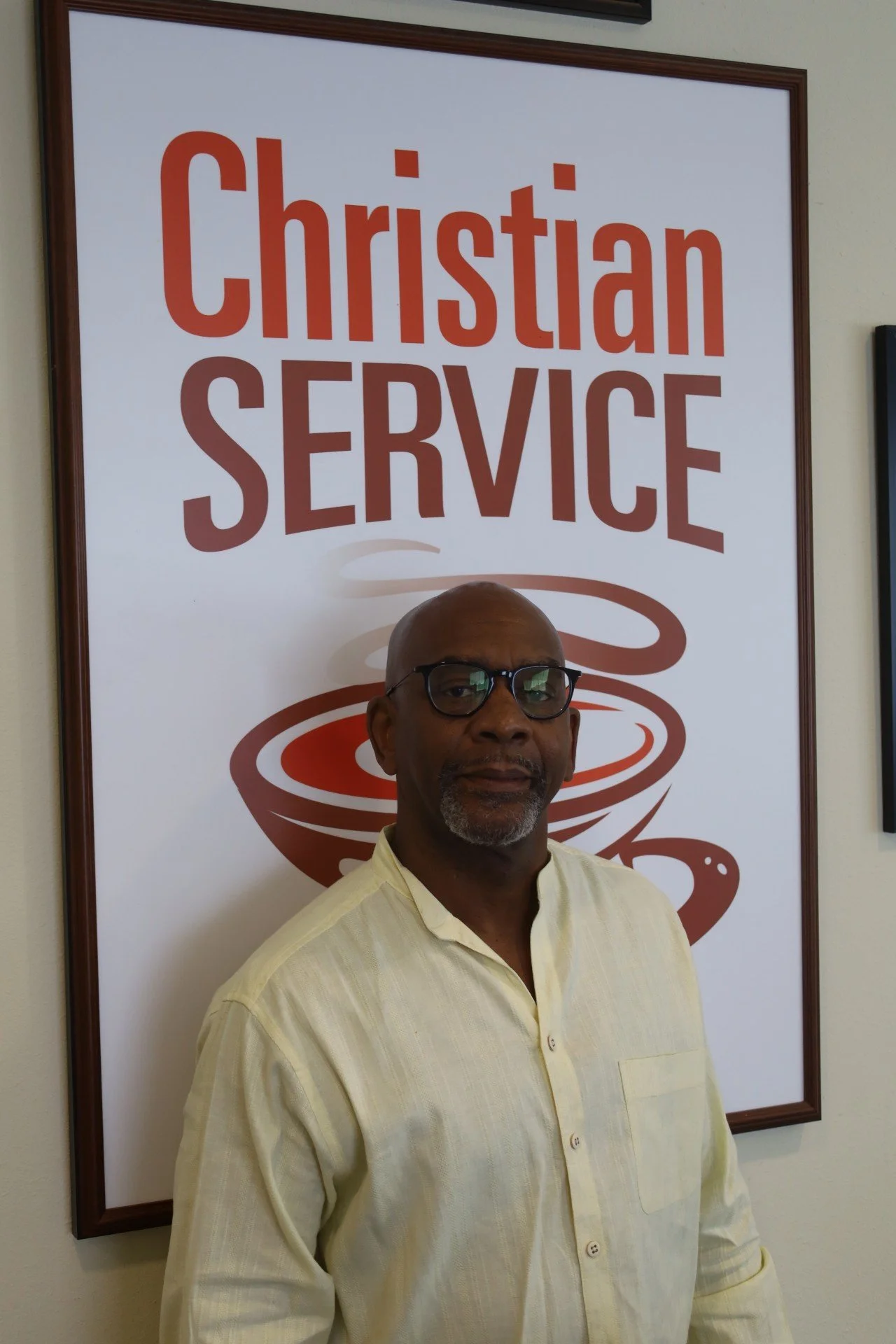
Al Moore has been the Executive Director of Christian Services since 2013 after Brother Giovanni, the director after Sister Margaret got sick. Moore is a Shreveport native, Navy veteran, and was also a football official for the NCAA Southland and Mountain West Conferences.
Providing for the basic need of hunger, Christian Services offers two hot meals a day. Open 364 days a year; they give between 1,500 to 1,600 meals a week, or about 9,000 a month. Shreveport native Al Moore has been the Executive Director of Christian Services for thirteen years. On their place in the community, Moore said, “an individual can come to Christian Services and get a hot meal with their head down and leave with their head up. That’s a blessing to me.”
Moore was born in Shreveport and graduated from Fair Park Highschool in 1981. Shortly after, he joined the Navy. After returning to Shreveport, he was offered a position as an engineer for KTAL Channel 6. After watching and learning from the newscaster, he realized that newscasting was the job he wanted. He then got his bachelor's in communications at Southern University in Shreveport.
In 1990, still funded only by donations, together with Cablevision of Shreveport, Sister Margaret began holding a sixteen-hour telethon. Running on a tight schedule, Sister Margaret would often talk well over her allotted segment time. Moore, now working for Cablevision, was first introduced to Sister McCaffrey and her ministry through these telethons. Moore said, “when we were doing the telethon, she used to go over her time. She was the type of woman that could talk and would talk to anybody,” he added, “and she wasn’t afraid to ask for what she wanted.”
The course of his career seems quite unlikely, but Moore says “I know it’s a blessing. God sent me here to do this job.” He recalled the day he was offered his current position at Christian Services in 2013. He had been working with them for 19 years and was a member of the board. Being a part of the board was taking up a large amount of his time and he remembers talking to his mom about resigning. Crossing over the Texas Street Bridge to the meeting where he intended to resign, he says, “I heard God say, ‘don’t resign tonight,’ and I heard Him say it perfectly.” The board offered Moore the position of Executive Director that evening.
In 2020, Christian Services celebrated their fiftieth birthday. That same year, they accomplished what Moore considers his proudest achievement: keeping their doors open during the Covid-19 Pandemic. Moore said, “that was a time we wanted to keep everyone safe. My employees were safe, no one caught Covid, and we never missed a meal. We kept doing God’s work every day.”
Currently, Christian Services is fighting the rising costs of food due to inflation, but Moore is sure that they will continue fighting to serve impoverished citizens of Shreveport. Moore encourages donations as they still do not accept federal funds. Moore also invites anyone interested in volunteering to reach out to them at 318-221-4857.
Martin Luther King Health Center and Sister Margaret
In 1985, Doctor Robert Jackson was Chief Medical Resident at LSU in Shreveport. He was born and raised in Shreveport, leaving for four years for college, and returning to attend medical school at LSU Health Shreveport School of Medicine.
The hospital had a charity program that would provide healthcare to those who needed it for free. Jackson noticed that the same people were returning time and time again. They suffered from seemingly manageable issues like high blood pressure and diabetes but would come back needing emergency treatment. He came to realize that they were struggling to afford the medicine that would keep them from needing emergency care. Jackson added, “it just didn’t make any sense to me that we would provide them with all of their hospital care, including intensive care, but not provide them with a pretty low cost and generally easy to get medicines.”
Unsure what to do about it, his dad pointed him in the direction of Sister Margaret. Jackson had never heard of Sister Margaret, but that meeting changed both his life and the lives of hundreds of Shreveport citizens.
On meeting Sister Margaret, he said, “as soon as I explained my thoughts to her, she got a kind of gleam in her eye.” This gleam was a common Sister Margaret feature. With no idea about the organization that it would eventually grow into, Jackson started seeing patients in the Christian Service’s hospitality house dining area on Saturday mornings. Armed with simple blood pressure instruments and handfuls of free sample medicines pharmaceutical companies sent to LSU, things started out slowly. Eventually, he garnered the trust of the community, and people started lining up.
While Jackson was unsure how far it would go, Sister McCaffrey helped shepherd them through the process of creating a board and becoming an official nonprofit organization. She also picked out the name: Martin Luther King Health Center. With his assassination happening the same year, the name was chosen to reflect King's ideas and the Beloved Community he fought for. Sister McCaffrey helped them raise enough money to continue the clinic in their own building in 1986.
Throughout its existence, Jackson shared there were a lot of times he did not think things would work out. Jackson said, “there were a lot of time I was personally kinda ready to give up, but Sister Margaret would not let me give up. She had a remarkable way about her to get people to do the things that she thought was right.” On how these conversations usually went, he said, “she would get this gleam in her eye or grin on her face and say ‘wow, you don’t really mean to stop doing this, do you?’ and it was just impossible for me to say no to her.”
In the ‘90s, as Sister Margaret’s health worsened, Jackson credits a lot of MLK’s success in fund raising to Executive Director Janet Mentesane. Jackson called Mentesane a master organizer and fundraiser. With these funds from grants and other sources, MLK Health Center was able to move into their current residence on Olive Street where they continue to help the uninsured, spread health information, and hold community events all in pursuit of the Beloved Community.
Jordan Scroggs and Martin Luther King Health Center
Jordan Scroggs is a Centenary alumnus and the current Executive Director at Martin Luther King Health Center. Scroggs is the first to admit that her path to the position was unique. Scroggs said, “when I started college, I knew who I wanted to be and what I wanted to do.” Scroggs fully intended to work at the State Department in Washington, D.C. and do diplomacy work. Through Centenary’s semester in Washington D.C. program, Scroggs got the chance to work at an organization adjacent to her professional interests. She quickly realized it was not actually where she wanted to be.
With three semesters left until she graduated, she started to panic. Unsure what to do, she found herself in Dr. Chris Ciocchetti’s office. He calmed her down and told her she had plenty of time to figure things out. In the meantime, he suggested she volunteer at MLK Health Center. Ciocchetti was leading a rebrand of MLK Health Center at the time, and Scrogg’s job was interviewing patients to share how MLK helped them. Despite her fear of doctors' offices, she said these interviews had a major impact on her.
Scroggs shared that her dad had a chronic condition and did not have health insurance. Scroggs said, “as I was interviewing people, I started to hear some of my story in theirs. I saw my dad struggle for decades and the toll that it took not only on him, but on the family as a whole.” These feelings stuck with her long after her volunteering was over.
In 2013, Scroggs graduated from Centenary and moved to Austin, Texas. A few years later, she moved back to Shreveport to be closer to her family. She reached out to Mentesane, the Executive Director at the time, and asked to take a tour of the center as it had moved buildings since the last time she was there. She started on the team as social media head until one day she got a straightforward email. Scroggs said, “Janet is very direct, very to the point. It was a one sentence email. It said, ‘have you ever thought about becoming an executive director?’”
Over the next five years, Mentesane mentored Scroggs until she took over on Jan. 1, 2021. Scroggs said, “I do not have a medical background. I still do not like needles. But I believe deeply in the work that we are doing.”
When asked about her time in college, Scroggs said, “I was able to take over leadership at MLK so young because of the training I got at Centenary that taught me to sit at tables with people who were older than me and still find value in my space at the table.” She also hopes students learn from her experiences and try the things they hope to pursue. Scroggs said, “if you think you know what you want to do, great. Try to find someone who’s doing it and just check in and make sure that really is what you think it is.”
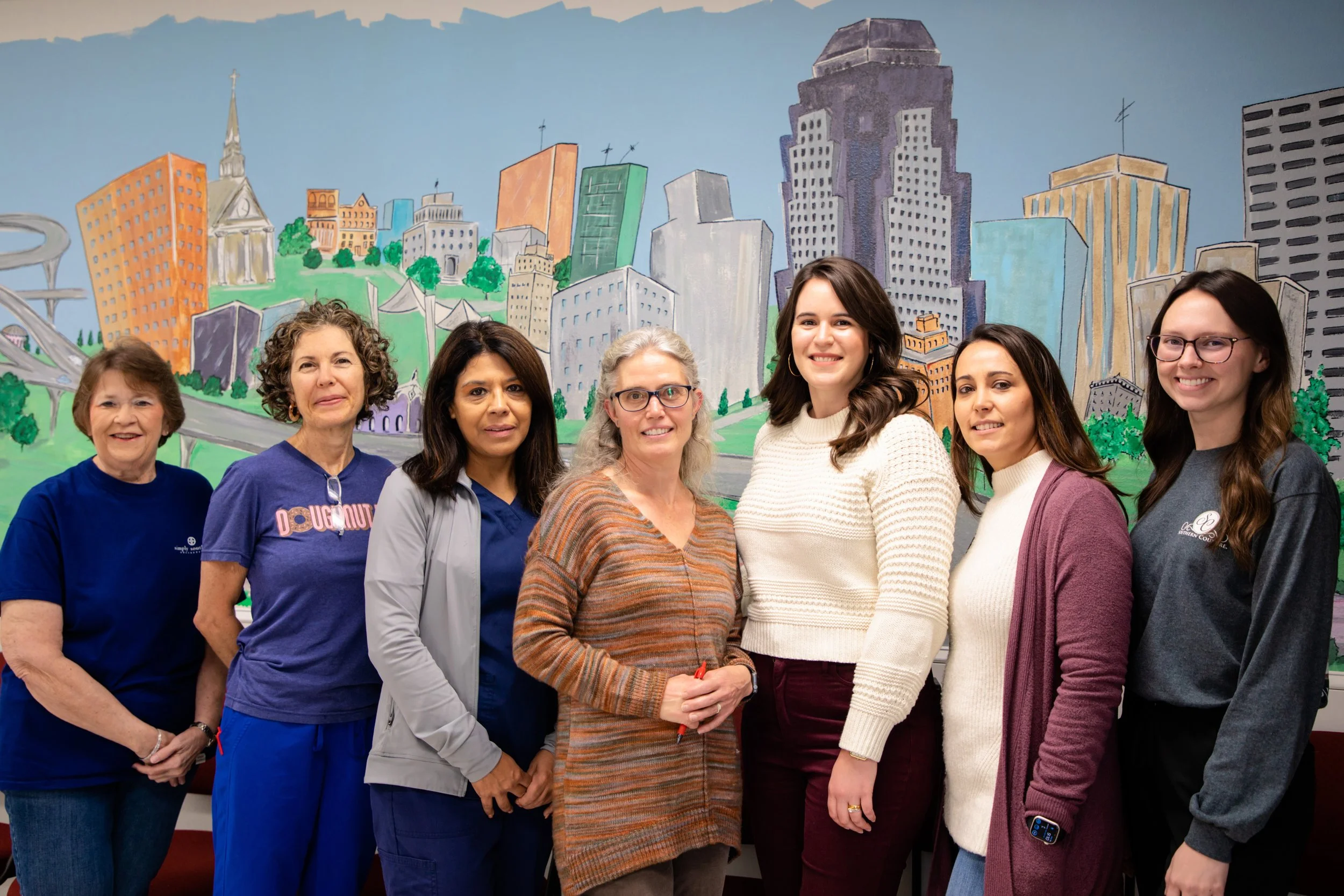
A group photo of the MLK Health Center Staff in front of a Shreveport mural on the wall of their waiting room. From left to right: Sue Walden, Brenda Nims, Marilu Rodriguez, Jennifer Donner, Jordan Ring Scoggs, Melanie Douglas, Skylar Williams. (SB Magazine)
Sister Margaret and Controversy
These individuals represent the legacy of Sister Margaret and the work she poured into the community. However, Sister Margaret’s views were not always received well. She was heavily invested in politics, protesting the death penalty, advocating against climate change, and, most controversial, speaking out against the Gulf War in 1990.
She claimed she was not political, but instead, in an interview about her stance on the death penalty, she said, “I just don’t believe we can work to help people with these problems and not speak out about them.” She went on to explain that the death penalty disproportionally effects minorities and the impoverished as they do not have the money to levy a strong defense.
She led a handful of protests against the Gulf War despite the insults and denouncements she received from others. When others questioned her patriotism, she responded, “I feel a responsibility to speak my conscience when I don’t feel we’re doing what we’re called to do. That’s true patriotism.” While the annual Christian Services telethons saw a decrease in funds, Sister Margaret spoke her mind up to the very end.
Sister Margaret’s Final Message
In 1997, she was suffering from cancer, and there was a lot of uncertainty circulating around who would take her place at Christian Services. On Dec. 16, she received a message from the Bishop of Shreveport, William Friend. Sandwiched between condolences for her illness and assurances that they would help in whatever ways they could, Friend questioned who was filling her shoes. Multiple people had reached out to him with interest in the job, and he was hoping to be included in the transition process.
On Christmas Eve, Sister Margaret responded in trademark Sister Margaret fashion. Sister Margaret wrote, “Since the beginning, this program has never received support nor involvement from the Diocese of Alexandria, Diocese of Alexandria-Shreveport, nor the Diocese of Shreveport.” She explained that the program had always been an inter-faith and inter-racial program and “therefore, at this time the only qualified persons to make the decision as to the future of the program and its new leadership is I, as coordinator, and the Board of Directors,” adding, “we are the only ones who truly understand the philosophy of the work and its purpose of existence.” She then, naturally, goes on to explain the philosophy she has worked with in her thirty years serving Shreveport:
“We are here to serve our brothers and sisters who are without the basic necessities of life. We are not here to judge anyone, nor to instruct people on how to live. We are a loving presence amidst those who have lost their own sense of worth. We are here to learn from the people we serve, the people who minister to us.”
Fifty years since she first came to Shreveport, her work is not done. However, Sister Margaret’s life continues to echo throughout the city because of the people and places she set into motion. This is the legacy that Sister Margaret McCaffrey leaves behind.