Growing Up With AI: What the Future Holds for the Next Generation
Today's students are coming of age at a strange inflection point: one where the tools reshaping their education, careers, and daily lives are evolving faster than anyone can fully evaluate them. Two professors who study AI closely, Dr. Denise Robb and Dr. Rachel Johnson, offer a picture of what that means for the generations growing up inside it: not a future of easy answers, but one that demands constant, active engagement.
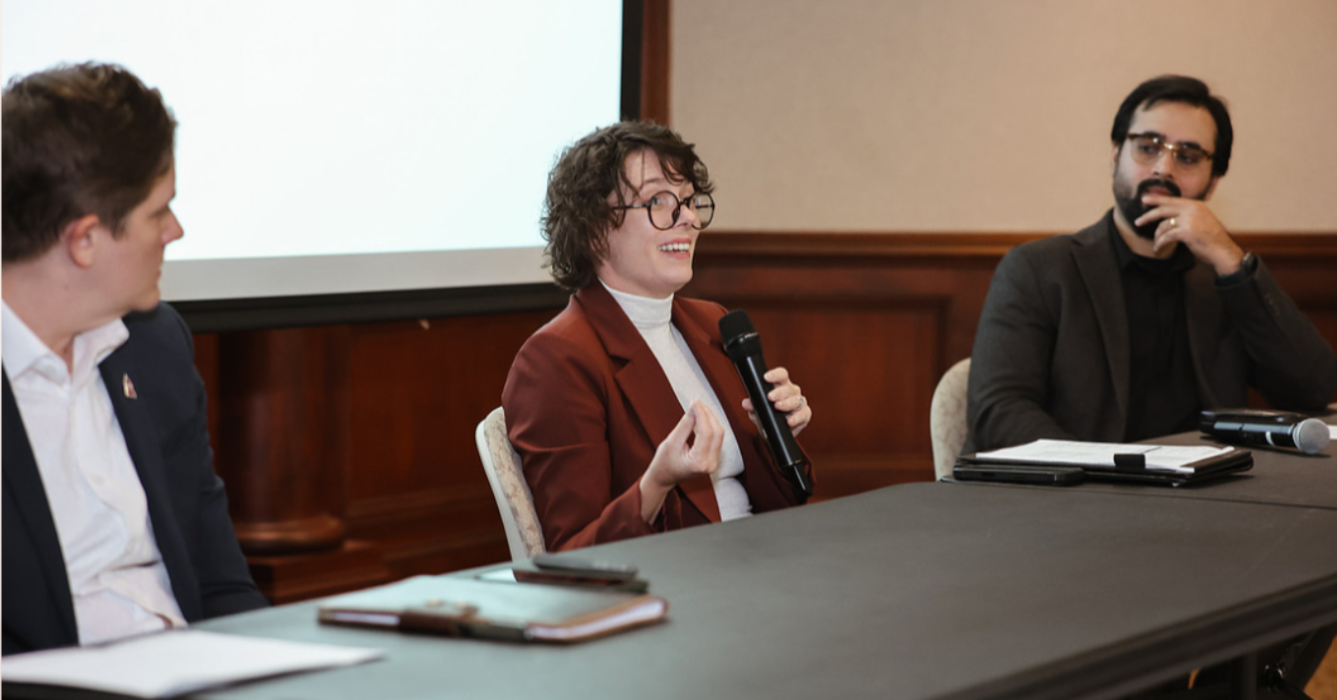
Dr. Denise Robb describes how AI harms confidence and engagement. Robb is pictured between Dr. Rachel Johnson (left) and Dr. Rudrajit Banerjee (right).
The first shift future generations need to make, according to Robb, is understanding what AI actually is.
"I think what messes with people is that it's called artificial intelligence, but really, it's like collated intelligence," Robb said.
It doesn't think; it aggregates. That distinction matters because it changes how much trust the tool deserves.
"AI lies," Robb warned, noting that it can fabricate citations or misread sources entirely. Young people inheriting these tools will need to build in real-time fact-checking as a reflex, not an afterthought.
Johnson frames the challenge in historical terms, as part of a much longer pattern.
"New technologies related to writing have been coming out for as long as we've been writing," Johnson said. "Every time a new technology emerges, it changes a lot about the practice of writing."
Her takeaway for the next generation is less about resistance and more about literacy: "We have to engage with emerging technologies and try to understand them better, even if we ultimately decide not to use them."
Perhaps the most pressing concern both professors raise is what happens to skill and confidence when a generation grows up leaning on AI. Robb's own research on high schoolers found that heavy AI use didn't build confidence, but eroded it. Students who relied on the tools reported feeling "less confident in their abilities" than those who didn't. She compared it to losing basic cooking skills after switching to pre-made meals: the muscle simply isn't there when it's needed. This concern has real implications for a generation that may never develop certain foundational skills unless they're deliberately protected.
Johnson sees the same risk through the lens of process.
"The goal of having you write the paper is to impact your learning, to help you think," she said. "If someone is using AI to bypass thinking... then that's an example of avoiding the work."
For future generations, she argued, the line won't be whether they use AI, but whether they use it to engage with a problem or to skip past it entirely. This would be using it, for example, to understand an unfamiliar citation style rather than to avoid writing altogether.
Future generations will also inherit AI systems shaped by the biases of the people who built them, a reality both professors say needs to be taught explicitly, not discovered the hard way.
"Anytime a product is created, it's going to be created in the image of, and to benefit... whoever the person's creating it," Robb said, comparing AI tools to scissors: designed by default for right-handed users, with everyone else treated as an afterthought.
Learning to recognize whose perspective is baked into a tool, she suggested, will be a basic form of literacy going forward.
Johnson extended this further, arguing that the next generation won't just use AI, but they'll live under the weight of decisions made about it by powerful institutions today.
"I think any tool that is very powerful should be subject to public scrutiny and potentially regulation," she said.
Drawing on philosopher Martha Nussbaum's framework for "cultivating humanity," she pointed to three habits she hopes young people carry forward: critical self-examination, genuine concern for other people, and narrative imagination: "the ability to imagine how someone else might feel." Those habits, she suggested, are what stand between a future shaped responsibly and one where the human cost of these tools gets ignored.