Centenary Students Prepare for Election Day on Nov. 3
Nov. 3, Louisiana voters can cast ballots for the U.S. Senate, U.S. Representative primary, Shreveport Mayor, Caddo Parish District Attorney, Shreveport City Court, Judicial District Court, Shreveport City Council, Louisiana Supreme Court, Public Service Commission, and Louisiana constitutional amendments. This will be the first opportunity to vote for many freshmen at Centenary. When people think about voting, presidential elections are often what comes to mind. However, there are many smaller elections that make up our local and federal governments.
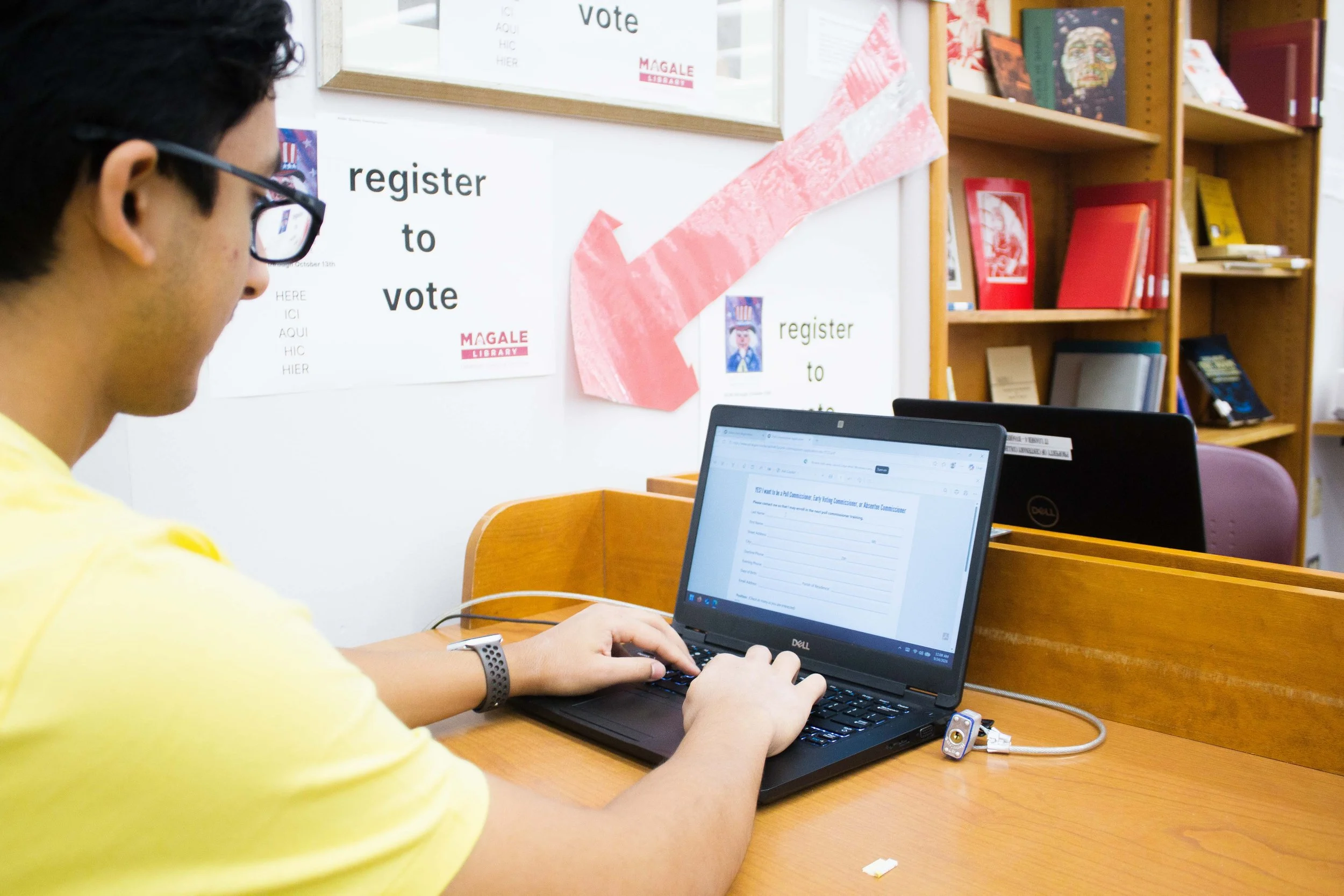
Centenary student Ariv Kohli registers to vote at Magale Library ahead of Election Day on Nov. 3.
Smaller elections are often overlooked. Despite their importance, not all voters are aware of these local elections. They tend to receive less media attention, requiring more effort to find information. While electing all these different officials may seem overwhelming to new voters, even these local elections have the potential to impact your city and your life. Mayors, judges, school board members, commissioners, and more make decisions that can completely shape your local community in areas such as public safety, budgeting, economic development, policy agenda and more. For college students, these decisions impact the city they will live in for the next four years and where they may choose to stay after graduation.
There are very few steps needed to be able to vote. Eligible voters must be 18 years old and registered to vote 30 days prior to the election in Louisiana. From Sept. 21 to 25, Pre-Law Society held a voter registration drive on the Caf Deck. This allowed Centenary students who were not yet registered to get help registering for the next election.
Keagan Malone, a junior political science major, acknowledged the waiting period between registering to vote and receiving a voter registration card.
“Get registered early,” Malone said. Given her academic background, when picking a candidate, she strongly believes in “doing your research on the person and not just what they say.”
Voters are also required to present photo identification while voting in 36 states. Voter Identification laws have been controversial throughout history. While supporters argue that they prevent voter fraud and have no effect on voter turnout, those against identification laws believe that they are unnecessary, burdening for voters, harm voter turnout, and target minorities. States vary on these laws, with some requiring strict photo ID, strict non-photo ID, some simply requesting ID, and others with no documentation required at all. Louisiana is a non-strict photo ID state. If you do not have a photo ID, you must vote on a provisional ballot and return within five days to show ID.
For college students, the process can be even more complicated. College students have the choice to vote in either their hometown or their college town. Out-of-state students who choose to vote in their home state must request an absentee ballot to cast their votes by mail.
Giselle Gonzalez, a freshman political science major who has not yet voted, is registered in her home state of Texas. She expressed confusion about how voter registration works for someone attending college in another state. When preparing for her first election, Gonzalez said “I think I would just want to know who’s running at the time.”
Voter turnout measures the percentage of a population that casts votes in an election. There are different types of voter turnout that can be measured, such as registered voter turnout, the percentage of registered voters who vote, and eligible voter turnout, the percentage of eligible voters who vote.
Statistics show that young, eligible voters have a significantly lower voter turnout rate, around 10 points or more below that of eligible voters 30 and older. For new voters, voting can seem like a confusing and complicated process. Rather than not wanting to vote at all, the issue is usually not knowing where to start. However, voting is important because it’s a way to have your voice heard. It is your chance to voice your opinions and vote for officials who will represent you and your beliefs. Throughout history, not everyone has always had the right to vote, but we currently live in a society where our voting rights are protected by law. Ultimately, voting is the chance to participate in our communities and shape the future.