Declining Student Loans Signal Progress in Access to Education
Student loan borrowing in the United States has reached its lowest point in over a decade, signaling a significant shift in how students fund their education. At Centenary College of Louisiana, where 69% of full-time undergraduate students receive student loan aid, this trend is particularly relevant. Through robust financial aid packages, Centenary exemplifies the national movement toward reduced reliance on student loans.
For students like Laura Pizarro, a freshman English major, Centenary’s financial aid has made all the difference. “The financial aid that Centenary has provided me is very substantial and generous. I feel more secure in my future and post-graduate education because I will graduate with little to no debt, and I am grateful to Centenary for that.” With scholarships covering most of her costs, she expects to graduate with significantly less debt than she anticipated—a growing reality for many Centenary students.
Across the country, the average federal loan per undergraduate student fell to $6,575 in 2022-2023, down from its peak of $9,719 in 2009-2010. At Centenary, the average federal loan is even lower, at $5,407. Generous aid packages, which include institutional, federal, and state support is key. Every first-time, full-time undergraduate at Centenary receives grants or scholarships, with awards averaging $32,506 per student. Of this, $27,109 comes from institutional aid, helping students access a high-quality education without the overwhelming financial strain.
Sarah Baquedano, a biochemistry major, has experienced this impact firsthand. “I feel relieved because I do not have to worry about paying for college, and I feel like my discipline and hard work have been rewarded. But most of all because I can use these years to save for med school,” she says. With a full scholarship and FAFSA aid, she represents the growing number of students benefiting from financial aid that allows them to focus on their futures rather than mounting debt.
Nationally, total borrowing by students and parents has been declining for 13 consecutive years, driven by increases in grants and scholarships. Pell Grants, for example, saw their maximum award rise to $7,395 in 2023-2024, the largest increase in over a decade. At Centenary, 40% of first-time students receive help from Pell Grants, with an average award of $5,100. Additionally, 58% of students receive state and local grants, averaging $5,560 per recipient, further easing the financial burden.
Despite this progress, some students still find themselves navigating challenges in the financial aid system. A junior majoring in biology and neuroscience, who prefers to remain unnamed, explains that while Centenary provides substantial support, federal financial aid often falls short due to its reliance on parental income. “I feel like the scholarships Centenary gives are pretty fair. I just think it is a national problem that my financial aid is decided based on what my parents make when they are not necessarily helping me pay for school.” This concern reflects a broader issue in higher education funding, where federal aid calculations do not always align with students’ financial realities.
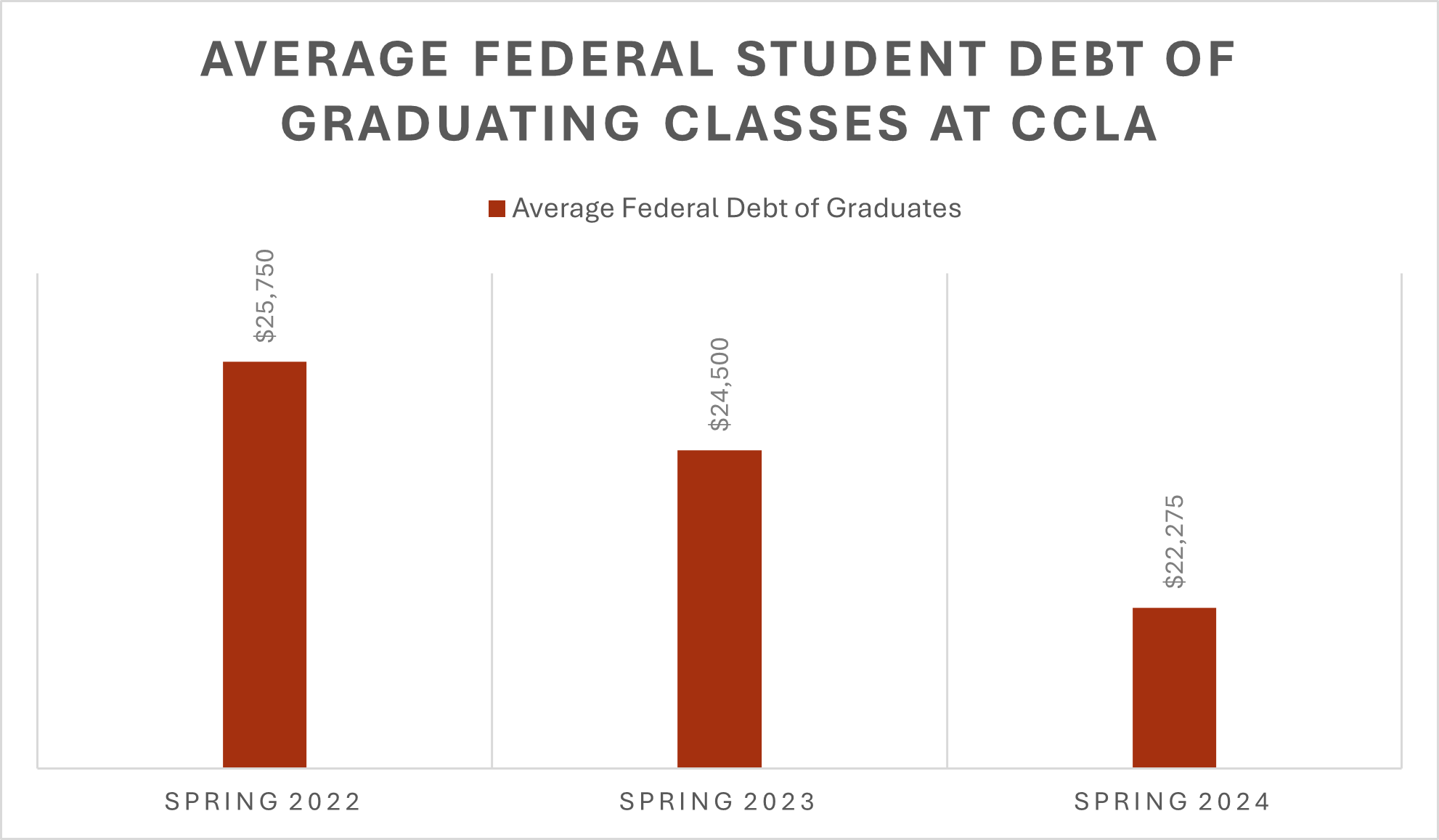
This trend of declining student debt is also reflected in the average federal student loan indebtedness for Centenary’s recent graduating classes. According to Lynette Viskozki, Director of the Financial Aid Department at Centenary College of Louisiana, the average federal student debt for graduates has steadily declined. For the Class of Spring 2022, the average debt was $25,750; for the Class of 2023, $24,500; and for the Class of 2024, $22,275. These figures highlight the impact of Centenary’s financial aid initiatives, ensuring that students graduate with less financial strain year after year.
While federal borrowing is declining, some students still rely on private loans, averaging $17,176, which often come with higher interest rates. Yet the progress made in reducing borrowing shows the power of financial aid to transform lives. At Centenary, the focus on accessibility and affordability ensures that more students can graduate with less debt—or without it altogether.
For Laura, Sarah, and many others at Centenary, the promise of education is one of opportunity without crushing financial worries—a future where every student’s story matters, and education truly opens doors.