Not to Know More, but Become More
From music and tradition to a lesson in ramps, levers, and pulleys, Centenary’s President’s Convocation inspired students to think about the tools they will gain during their college experience.
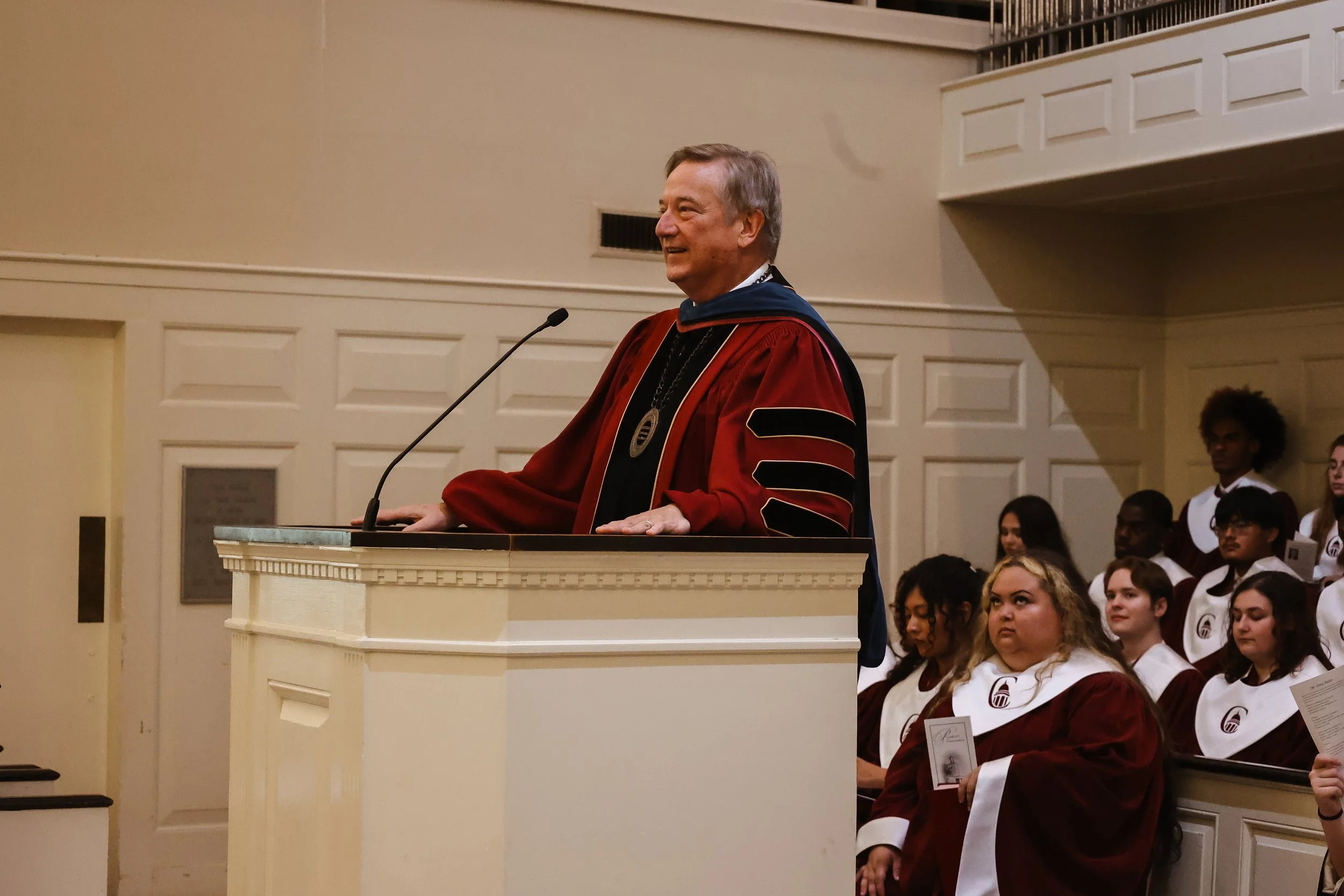
President Holoman gives his speech in Brown Chapel on Aug. 25, 2026. (Centenary Marketing)
In the Brown Chapel, Dr. Holloman begins every academic year with a welcome ceremony that brings together students, faculty, staff, and the Centenary community. Reverend Maddie Russo started the convocation with an encouraging prayer for the upcoming semester. Centenary’s world-renowned choir led the audience in hymns. Centenary’s provost, Karen Soul, spoke about the importance of the convocation and how it welcomes students and faculty, giving them a fresh start and encouraging them for the possibilities and opportunities ahead.
President Holoman gave an empowering speech about “filling your toolbox.” College gives students tools that they can use beyond their college experience and throughout their lives. These tools are more than the information you learn in classes. Dr. Holoman discussed the importance of a liberal arts education. He explained that it exposes students to different ideas and subjects. Students can develop a variety of skills instead of focusing on one specific skill. The goal is to prepare students for challenges they may not expect.
The first tool in the toolbox is “the ramp.” Difficult goals become more attainable when approached gradually. There is not just one way to overcome obstacles, and it is important to problem-solve and find different solutions. Progress will not always happen immediately, and some goals take much longer to achieve. The path may be longer, but that doesn’t mean it is unreachable. Every class and experience helps students slowly work towards their goals. Challenges may feel steep, but students can find ways to work through them.
A lever is a tool that helps someone move or accomplish something that would be difficult alone. President Holoman told students they do not have to solve every problem on their own. It is not shameful to ask others for help. They can provide support, advice, and encouragement. People can accomplish more when they accept help from others. Students may not want to admit they are struggling or may be afraid to appear weak, but Dr. Holoman reassured them that asking for help can make difficult situations easier. Classmates, advisors, professors, and coaches are here to support your journey. President Holoman states, “Asking for help is wisdom, not weakness.”
The wheel and axle provide movement, progress, momentum, and working toward a destination. Students should keep moving forward. Their education is constantly developing them and will continue to evolve. Dr. Holoman emphasized that even when students face setbacks, they can keep progressing. Every experience at Centenary can help move you closer to your goals.
The third tool is “the pulley.” The liberal arts education should benefit more than just the student receiving it. Dr. Holoman highlighted that education is about service. A successful education impacts the community. Students can use their skills and talents to make a difference in the people around them. Centenary is part of a larger community that goes beyond the classroom.
The wedge creates an opening that was not there before. Dr. Holoman explained that education can introduce students to possibilities they hadn't considered. Students create opportunities by being curious and asking the ‘why.’ President Holoman stressed the importance of asking questions, and curiosity can create new discoveries. Questions can challenge assumptions, and a liberal arts education allows students to explore different perspectives.
The final tool in the toolbox is “the screw.” President Holoman explained that each small turn gets you closer to the end goal. One class adds to earning a degree, one conversation can create a new connection, and one opportunity can lead to another. Dr. Holoman stressed the value of consistency. Success doesn’t happen all at once.
Lastly, he stated that a liberal arts education is “not to know more, but to become more.” Your college experience is about more than earning a degree. It is about building a toolbox for your future.