English Major Rambles: Tell Me, O Muse, of a Modern Man
I don’t take my Letterboxd account too seriously. I mostly use it as a quick reference for all of the movies I’ve watched and for my at-a-glance thoughts about them. But before I watched “The Odyssey,” and even before it came out, I knew I was going to have complex thoughts about the film. So when I did see it, I logged that I had watched it but left no rating or comment. One of my friends then texted me and asked why I didn’t say anything about it, and I responded that my thoughts were too complicated for a couple-sentence review written right after I watched the film. Instead, I wrote a more-than-a-couple-paragraphs reflection of my thoughts.
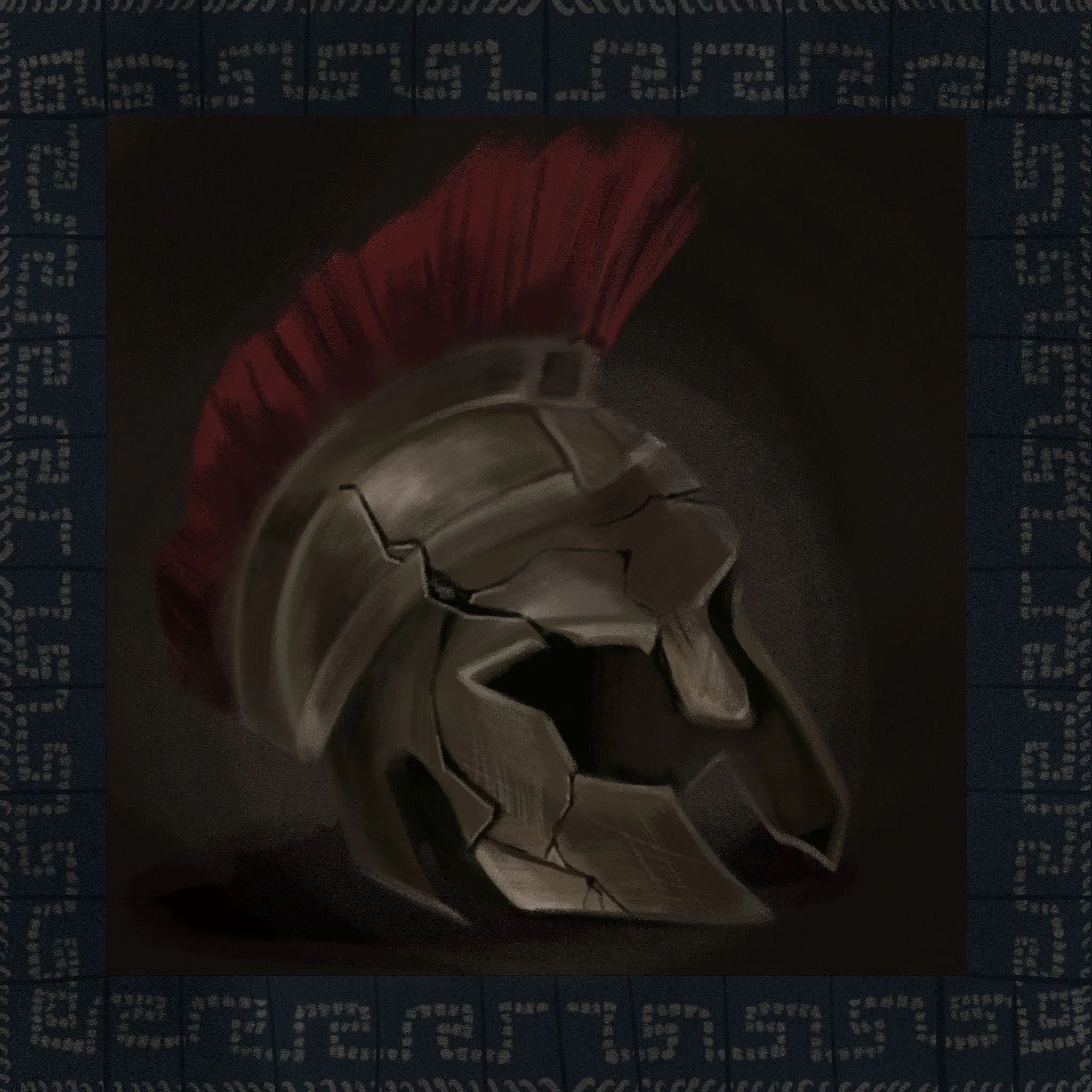
Illustration by Ava Agee
“The Odyssey,” written and directed by Christopher Nolan, premiered July 6, 2026. Taking its title and story from Homer’s epic poem, this is not the first time that the work has been adapted into film, but it has stirred up discussions about how to “correctly” adapt this millennia-old story.
“The Odyssey” marks Nolan’s thirteenth film, and, when one looks at his filmography, it is obvious why he was drawn to moving the epic onto the big screen. The basic idea of a man questioning his own morality while trying to journey back to his loved ones is a throughline in Nolan’s films, such as “Inception” and "Interstellar.” Nolan also seems to love a film of grand scale, from over three-hour run times, a collective of billions spent on film budgets, filming exclusively on IMAX cameras, and physically harsh practical effects. An adaptation of Homer’s “Odyssey” was never going to be humble, and two-time Oscar winner Nolan seems like the man to be able to tackle such a project successfully.
In response to the boom Nolan created, another adapter of Homer’s “Odyssey” recently gained more attention. Emily Wilson is currently a professor of classical studies at the University of Pennsylvania. She was the first woman to translate Homer’s “Odyssey” into English verse in 2017, and her translation of “The Iliad” soon followed in 2023. Wilson’s decision to use the same number of iambic pentameter lines as there are hexameter in the original text forces the language she chose to be much more concise, and it strips away the floweriness that has built up over the years into something clean and, arguably, more modern. Because of the new perspective Wilson brought to the centuries-old text, many looked to her as the standard when Nolan’s adaptation was finally released.
Although the majority greatly enjoyed Nolan’s “The Odyssey,” gaining a rating of 8.5/10 on IMDb, 94/100 on Rotten Tomatoes, and 4.4/5 on Letterboxd, Wilson quickly released two articles on the topic, “A Trojan Horse Is Supposed to Have Humans Inside of It” and “An Uncomplicated Man.” The latter article is a reference to the first line of her translation of “The Odyssey”, which she, controversially, wrote as “Tell me about a complicated man,” a deep contrast to another translator, Samuel Butler’s, “Tell me, O muse, of that ingenious hero.” Nolan referenced Wilson’s translation and that beginning line in an interview with Empire Magazine when talking about how the character of Odysseus is not purely a soldier but a wily strategist.
Wilson’s criticism does not lie with the grand scale of the film, as everything seems appropriately vast, or even the performance of the actors, but more so with Nolan’s writing. Wilson’s largest critique is exactly what her title says. Despite Nolan using her translation, or that first line, as reference, the Odysseus portrayed in his film is uncomplicated, or at the very least, inconsistent. Wilson references this simply, “Verbally, we are told that people matter; visually, we are shown that they do not.” The Trojans are faceless, helmeted people being massacred, and even though it is clear the film wants the audience to understand that Odysseus is feeling morally conflicted about taking advantage of Zeus’ law and using trickery to slay the Trojans. When he does the same to the suitors in Ithaca, it feels as if the film does not want the audience to question if that was right in the same way as in Troy. Moral conflicts are built up but not followed through. Odysseus is the protagonist of the story, therefore he is the hero, saving his wife and child and literally sailing off into the sunset.
Within culture, ideas of morality are something that change over time and that cultural context will always alter and affect any adaptation or translation of a work, and for something as old as the story of the “Odyssey”, it can be almost impossible to know what the “true” or “correct” version of the story is. The poem was part of oral tradition, being performed verbally by bards for centuries before it was ever written down. Since there was no standard text, events of the story could have been completely altered from person to person based on who they heard it from. This makes it difficult to proclaim that there is a right and a wrong way to do an adaptation of the “Odyssey,” as it has undoubtedly changed many, many times across thousands of years and cultures.
Wilson does address how adaptation always makes changes to the material, and she specifically references how the concept of deception is portrayed in Homer’s “Odyssey” compared to Vergil’s “Aeneid.” The addition of the character Sinon, who purposely lies to the Trojans about the horse, saying that Athena will save them if they take the horse into the city as a sacrifice for her, pushes the audience to ask if cities sometimes fall because its people are noble or, in this case, pious. During the time that Vergil was writing, Augustus was the first Roman emperor who manipulated the Roman public to believe that his autocratic rule was in line with Roman tradition. The historical events of the period affect Vergil’s adaptation, taking deception from a morally-neutral tool of Odysseus to one of his moral failings.
Nolan’s version of “The Odyssey” is not incorrect. The Odysseus shown on screen might be a less developed and complex character than the one present in Wilson’s translation, but it can be argued that Nolan’s Odysseus is a character for a broader modern audience. As Wilson puts it, "he's an action hero who feels bad about being an action hero,” a type of character that appears in many blockbusters today. Nolan’s version is much more familiar to his modern audience, and it does not require the viewer to understand morality in the same way as the ancient Greeks. Wilson would argue this creates a weaker, less complex version of Odysseus, but this does not make the adaptation false. Nolan’s adaptation is just another version of the same story that has been told time and time again and will continue to change across times and cultures.
There are parts of Wilson’s reviews that get pretty scathing, and while she definitely is a knowledgeable source when it comes to Homer’s “Odyssey” and has critiques I agree with, I understand the choices and changes that Nolan made concerning modernizing the moral context. Wilson prioritizes the original ancient Greek culture, but if that was how Nolan crafted his film, his message would not have been clear to many modern viewers. Both adaptors had separate goals in mind during creation that match their cultural contexts, and that makes them both successful adaptations.