The Bronze Arms: A Series of Convocations
Sept 24., Centenary Professors Dr. Zunick, Dr. Rietveld and Dr. Lawrence began presenting a series of convocations relating their fields to “The Bronze Arms,” a collection of poetry focusing on memory and identity. The author of the book, Richie Hoffman, will be receiving the Corrington Award on Oct. 26. Designed for first-years taking TREK 115, the convocations center on three different ideas: how the book relates to memories and our sense of self, how it relates to art and the survival of myths, and matter and what we can learn from it.
Presented by Dr. Zunick, the first convocation focused on the influence of our past and memories on how we see ourselves. Zunick related the deep childhood memories of the author, like almost drowning, to stories of his own childhood as he questioned just how accurate these memories are.
“I decided to focus on the narrative identity part of the poem, this idea that memories inform who we are but our memories can be unreliable and our beliefs about ourselves can shape our autobiographical memories,” explained Zunick.
Zunick taught that when you are assessing your past self you are not actually remembering what you were like, but thinking of how you are now. In Zunick's words, “we are just using our memories in this way to tell whatever story we want to tell.”
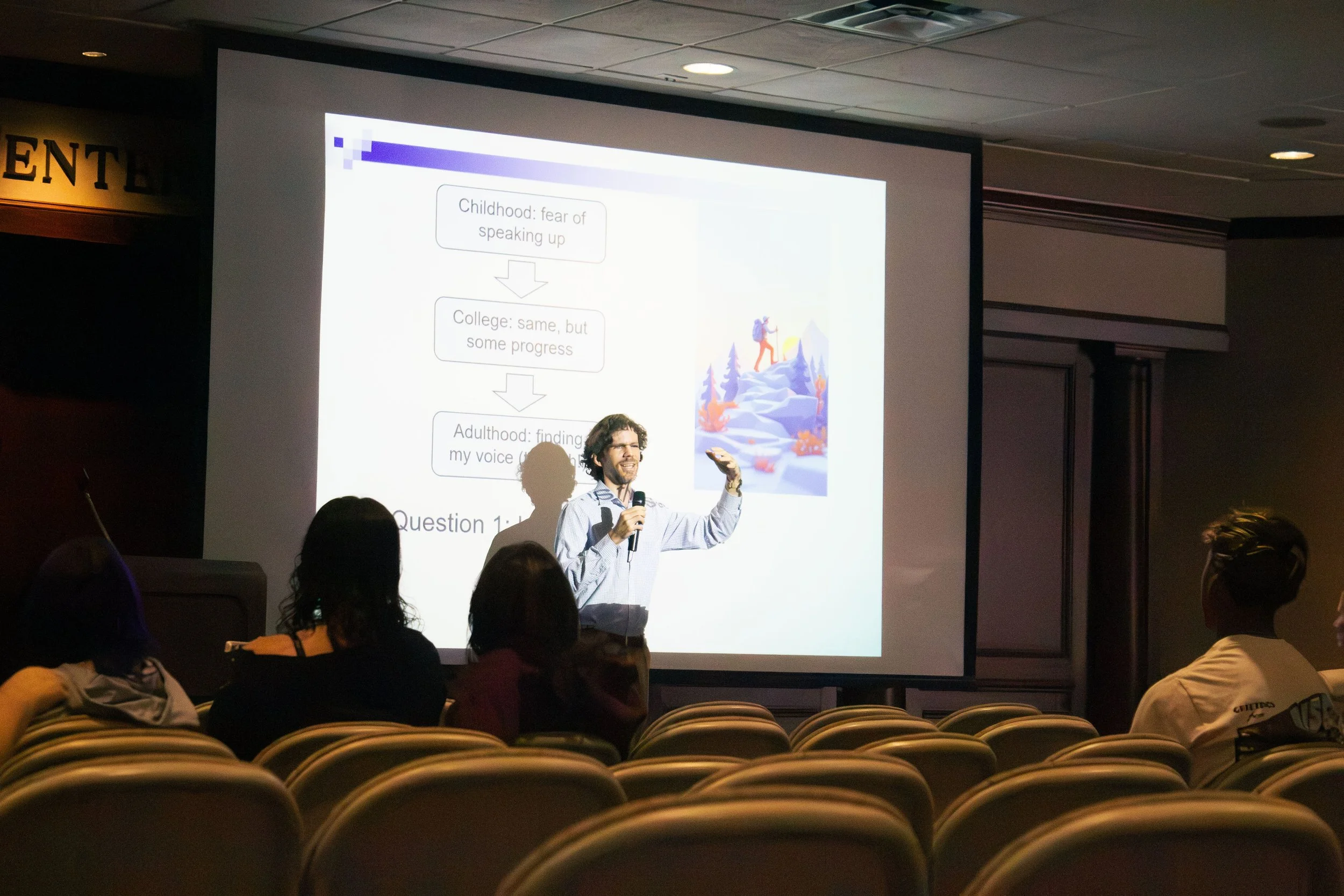
Dr. Zunick presents his convocation about psychology and “The Bronze Arms.” Students and others listen as he speaks about memories.
He also taught that when remembering positive memories they may not seem as distant as memories you wish to forget.
Zunick related this to the book, stating “I feel like a lot of the poems are about his relationships. It felt to me like the narrator was trying to explore how relationships can work… Some of the poems were bringing a window into this trial and error process of different ways of existing with another person. And I think a lot of how we learn about ourselves is through feedback from other people.”
As we shape our memories through our opinions on ourselves this can be influenced by truths given by others, similarly to the narrator in the book. One key takeaway from Zunick’s presentation is “not exactly not to trust your memories, but just a greater awareness of potential biases of how we are using our memories specifically to support narratives… or conclusions that we want to draw.”
Dr. Rietveld took the same story and told it from a much different point of view, diving into the history behind the locations of memories throughout the poems and the retelling of myths. Rietveld’s presentation focused more on “the foundations of the core memory that the author has,” the history of Crete, the mythology that shaped the island and the island’s cultural memory.
Rietveld connected this to Dr. Zunick's presentation, explaining that “we remember certain memories and adapt them slightly. This is the same that's happening with myth. Myth is able to survive, art is able to survive because we constantly change the meaning slightly.”
During her presentation Dr. Rietveld spoke of the legend of the Minotaur, the main myth relating to the island of Crete. The myth begins with a king, unsure of his worthiness, who asks for a sign from the gods to prove that he is fit to be a king. He is given a white bull as long as he sacrifices it back in a few months. When he fails to do so, he is cursed and the first minotaur is created. King Minos takes this personally and works with an inventor to create a maze where, every seven years, 14 children from Athens are sacrificed to the minotaur. Years later, a boy named Theseus is able to kill the minotaur.
This story was able to be passed on through archaeological recording as well as the interpretation of past people. It is now such a strong story that it is included in the history of Crete and how the Minoans, the ancient people of Crete, are remembered. It is an example of how myth tries to survive as “it attaches itself to cultural memory in specific ways and constantly readjusts itself to stay relevant, accurate and important.”
One key takeaway from Rietveld’s presentation is that “the past survives and mythology survives by constantly readapting itself. The story continuously changes slightly so it becomes part of our present.”
Though Dr. Lawrence’s presentation has not taken place yet, he will speak about matter and Bronze itself on Oct. 15. This will take place at the Shell Amphitheatre and will be an interesting talk about matter as it relates to “The Bronze Arms.”